56 Ready-to-Use Workflows
Complete, structured workflows across six business areas — each one built to run again and improve.
Build repeatable AI workflows for the repetitive work that keeps your business busy.
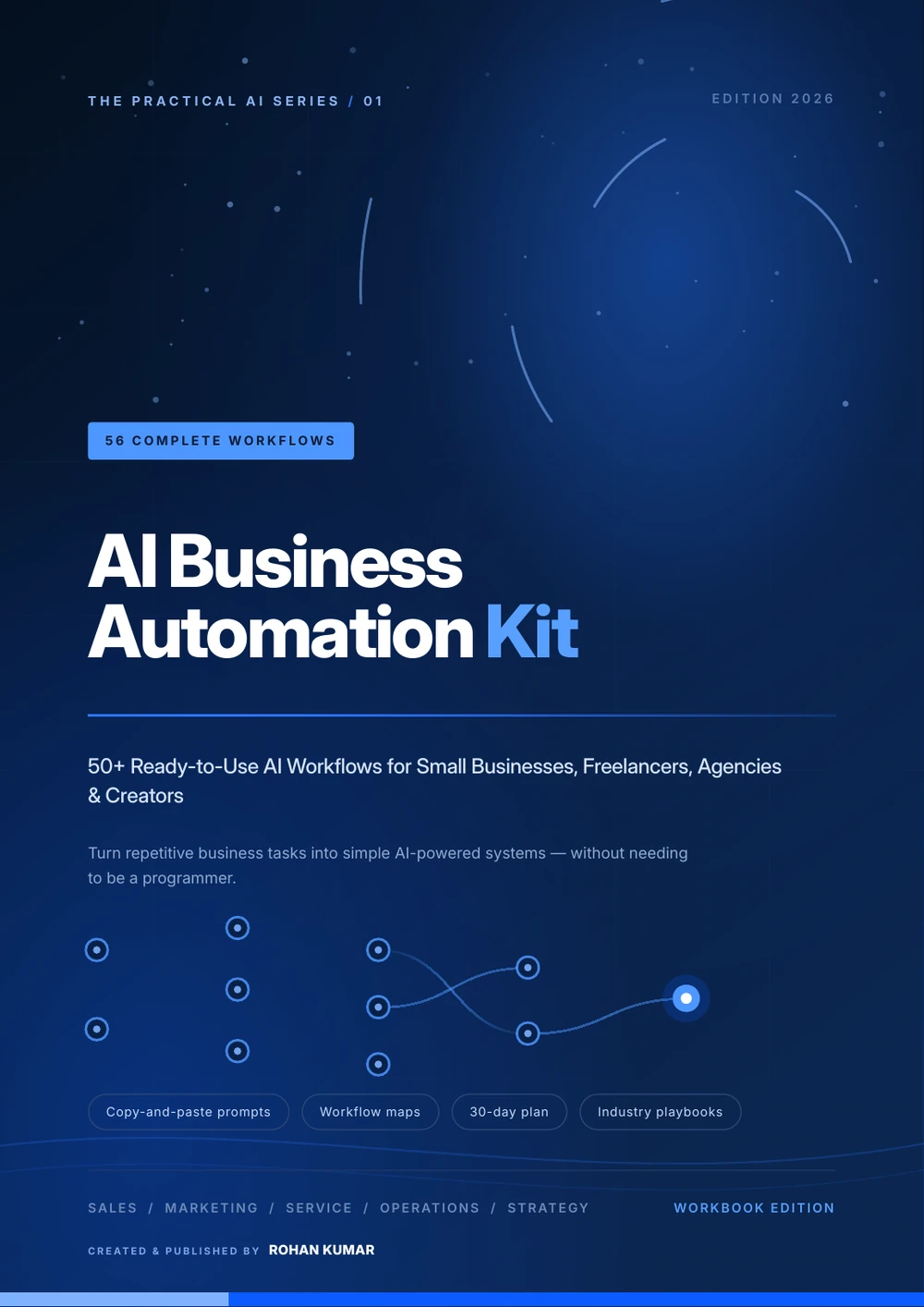
The AI Business Automation Kit gives you 56 ready-to-use workflows, copy-and-paste prompts, workflow maps, practical examples, quality checks and a 30-day implementation path — no coding required.
Built for small businesses, freelancers, agencies & creators.
A prompt is a one-off.
A workflow is something you run again next week, hand to someone else, and improve over time.
Prompts → Workflows → Implementation → Quality control → Better operations
Many business owners open an AI assistant only when they're stuck — ask it to do something from scratch, get a generic result, edit it manually, then repeat the whole thing next week.
Stop treating AI as a one-off helper.
Start building reusable workflows.
Complete, structured workflows across six business areas — each one built to run again and improve.
Every variable marked as a clear [PLACEHOLDER]. Fill in your details and run — no prompt-writing from scratch.
Each workflow shows the process from input to finished output — and exactly where the human step sits.
"In practice" examples show real input and abridged output, so you know what good looks like before you run it.
Every workflow ends with a specific checklist to verify before AI output touches your business.
The refinements that come from using each workflow repeatedly — not theory, but what actually works.
A scored, one-hour exercise that tells you where your time actually goes and which workflows return the most hours.
A paced, realistic plan — about 30 minutes a day — designed to survive a normal working month.
Starting sequences for common business types, each with a bottleneck, recommended workflows, and what to leave alone.
Reusable components, a diagnostic table, the complete index of all 56 workflows, and a glossary of terms.
Whatever repetitive task is eating your time, there's a good chance this book has a starting point for it. 56 workflows across six business areas.
Workflows 01–08
Workflows 09–18
Workflows 19–26
Workflows 27–36
Workflows 37–46
Workflows 47–56
Find the workflow closest to your bottleneck — you don't need all 56.
Real pages from the actual ebook — the contents, workflow anatomy, workflow 01, the audit, the 30-day plan, the industry playbooks and more. Tap any page to zoom.
One example of what a complete workflow looks like. It turns every raw enquiry into a scored, prioritised and ready-to-action record — before you read a single word.
You are an experienced sales qualifier for a [BUSINESS TYPE] business.
MY IDEAL CUSTOMER:
NEW ENQUIRY:
Return exactly this structure:
Rules: base every claim only on the enquiry text. Do not invent details.
Input: "Hi, saw your site. We're a 12-person dental practice in Leeds, our front desk is drowning in appointment calls. Need something sorted before our busy season in March. What do you charge?"
Output (abridged): FIT SCORE: 8/10 — named team size, deadline and pain point. BUYING SIGNALS: March deadline, asked price directly. MISSING: call volume, phone system, decision maker. ACTION: Call today.
Score reasoning quotes actual evidence from the enquiry, not assumptions. No invented details. Recommended action matches what you would have chosen manually.
Run it on your last 20 closed and 20 lost deals before trusting it live. If scores don't separate winners from losers, your ideal-customer description is too vague — fix the input, not the prompt.
Prompts are the starting point; workflows are the system. Each of the 56 includes what it does, best-for, tools, a workflow map, a prompt, an example, a quality check and a pro tip.
Sales, marketing, customer service, operations, strategy and productivity. Find the workflow closest to your bottleneck instead of searching generic prompt lists.
The industry playbooks show where human judgement should stay: drafts you review, regulated advice, confidential client information, and your own point of view.
About 30 minutes a day, four weeks, and a working system rather than a folder of good intentions. Start with three workflows — not ten.
Every workflow keeps a human review step. AI can be fast — your business still needs to be right.
"Too much admin. Too little time for billable work."
"Enquiries arrive while you're busy doing the actual job."
"Different people perform the same task differently."
"One idea has to become content across multiple platforms."
Industry playbooks also cover e-commerce, B2B / professional firms, agencies and growing teams.
Eight starting sequences. Each identifies the bottleneck, the three workflows to begin with, and — importantly — the one thing to leave alone.
Good AI strategy isn't about automating everything. These playbooks are written to keep judgement where it belongs.
About 30 minutes a day, four weeks, and a working system. Start with three workflows — not ten.
No automation yet. Read Part One, track your real week, write your standing context block and build your voice profile.
One workflow, implemented properly: fill placeholders, test on three past cases, refine, then use it for real.
Add two more. Consolidate days 20–21 turn a tool into a habit — the step most people skip.
Document as SOPs, measure hours recovered, decide where they go, and choose the next three.
Start with one. Make it work. Then expand.
Implementation capacity — not ambition — is the constraint that determines whether any of this survives a busy month.
Find the repetitive work in your business that could potentially be turned into practical AI workflows.
Get My Free Business Automation AuditA structured starting point based on your most repetitive task — not a sales call.
Your answers are used to send you the audit result and occasional practical follow-ups about building AI workflows.
Everything groups into one operating loop: Learn → Build → Implement → Verify → Improve.
This is not an "automate everything" book. Every workflow keeps a human review step, because AI can be fast — and your business still needs to be right.
Are claims, figures, dates and names verified against something you control?
Was anything attributed to a person, client or study that didn't actually say it?
Was any confidential or personal information exposed in producing this?
Does the output actually sound like your business rather than a language model?
Would you defend every sentence if a customer challenged it?
Sensitive information stays human. The book shows you what not to paste, how to redact, when to check your plan, and where human judgement must never be removed — including confidential client material and regulated advice.
No guarantee of results: outcomes depend on your business, execution and effort. AI capabilities and tools change over time.
Instead of staring at a blank AI chat, you already know which workflow to use, what information to provide, what output to expect — and what to check before using it.
"I use AI when I'm stuck."
"I have workflows for recurring work."

Digital product · Instant access after purchase
People who run the business and also do the work: freelancers and solo consultants, small agencies, local and service businesses, and creators, coaches and educators.
No. Every workflow runs by pasting text into a standard AI assistant. No code, no API keys, no developer required. Where automation platforms are mentioned, they're optional and clearly marked as a later step.
The book is deliberately built around standard AI assistants. It avoids quoting specific prices because the market changes monthly — but it's designed so you don't need an expensive stack to get started.
56 complete workflows across six business areas, copy-and-paste prompts, workflow maps, practical examples, quality checks, pro tips, a Business Automation Audit, a 30-day implementation plan, 8 industry playbooks, a reference library, a complete workflow index and a glossary.
No. A prompt is one part of a workflow. Each of the 56 is a structured system with what it does, best-for, tools, time, difficulty, a workflow map, a ready-to-use prompt, a practical example, a quality check and a pro tip.
Find the ones that match your bottleneck and use those. Don't try to read cover to cover or implement everything — the guide is designed around starting with the workflows closest to your recurring tasks.
No. Start with three workflows — not ten. Implementation capacity, not ambition, is what determines whether this survives a busy month.
A paced, realistic plan at roughly 30 minutes a day. Week one builds foundations, week two implements your first workflow, week three adds two more, and week four consolidates and systemises.
A scored, one-hour exercise in the book that tracks a real week, scores recurring tasks, and tells you which workflows will return the most hours. A free version is also available via the audit form on this page.
No — and the book is explicit about it. Every workflow keeps a human review step. AI removes the mechanical work; your judgement and quality control stay in the loop.
Yes. Language models can produce confident, plausible and incorrect information. Every workflow ends with a quality check, and you're responsible for reviewing anything before it's used or sent.
The book is licensed for your own business and client work you personally deliver. You can't resell or redistribute the ebook itself. Check the copyright page for the full terms.
It includes eight industry playbooks: freelancers, agencies, e-commerce, local service businesses, coaches and practitioners, content creators, B2B and professional firms, and growing teams.
You'll receive instant digital access to the ebook after a successful purchase. The payment gateway handles the transaction and redirects you to your download.
Choose one repetitive task.
Build one workflow.
Use it consistently.
Then expand.